

Louder than a bomb
staying human inside a system that depends on our indifference

Just a small post today. Yesterday it was harder than usual to remain hopeful and continue working and producing. Earlier I caught myself thinking I should say something. I thought about the Auden quote:
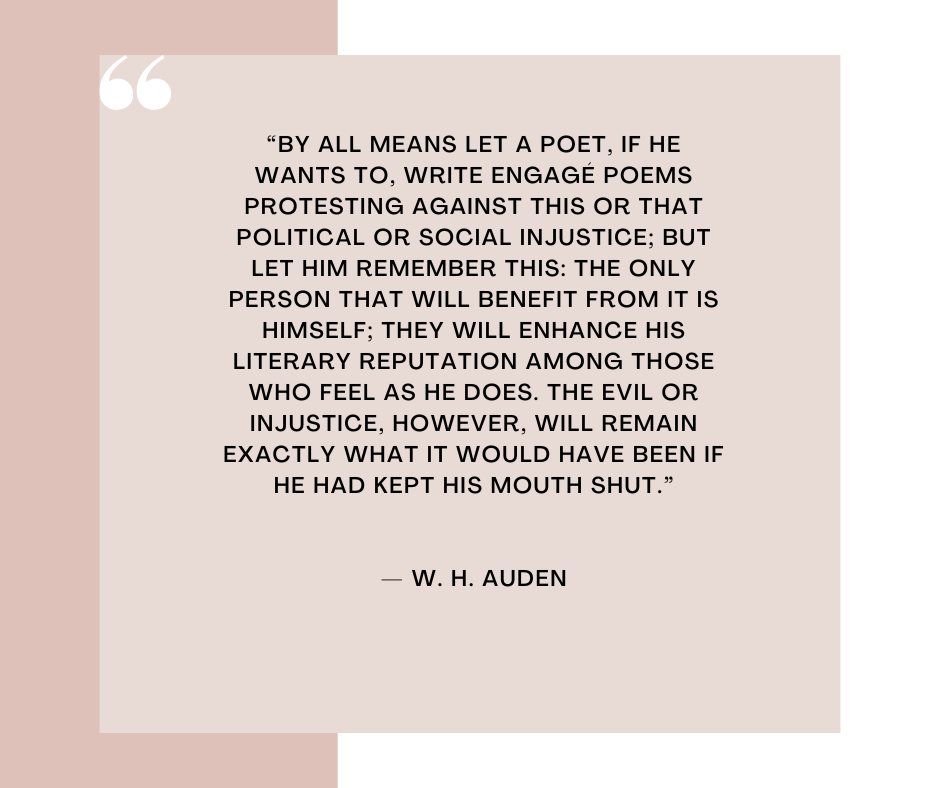
The quote attempts to dismantle the fantasy that there can be any consequence to articulation, that naming the problem is doing something. And yet, there is a pressure for writers and artists to say something. Silence has somehow become synonymous with complicity, and yet to perform one’s political stance is to assume that we need to continuously and publicly register our moral position. I have felt this acutely, that by not grabbing my personal social media megaphone is to fail, and yet that speech always feels insufficient. Who, exactly, is the audience for my speaking? Those in the echo chamber who already agree with me?
It is tempting to conclude, as Auden did above, that writing about injustices, war and atrocity is futile. That it changes nothing. That the evil remains exactly as it would have had we just kept our mouths shut.
That anecdote was about how violence enters the domestic scene of a home birth through sound, image, language; the horror of witness and the privilege of being born in the West, removed from the chaos of war. It is also a post about selection. Who is grieved. Who is named. Who is allowed to remain human in the telling. The violence does not arrive evenly distributed. My mum’s midwife saying she felt like a murderess for not praying for the bombers, who were ‘dead in their sins’.
In that post I also write about working with young poets in schools, in community projects e.g. Roundhouse SLAMs, Barbican programmes, youth arts initiatives shaped by the urgency of outrage. That feeling, in those rooms, that poetry could gather something. That shared language might become shared force. That saying it together mattered. Louder than a bomb.1
I wrote about the power of a room full of teenagers holding the same anger and hope at the same time. It felt like something approaching activism, even if it stayed inside language and the limits of those circles. It was comforting. Poems can’t stop bombs, but they can preserve the difficulty of seeing. They can interrupt indifference and resist apathy. They can provoke a form of survival against erasure especially when public speech can seem dangerous. They can be refusal to accept what is happening as normal; a survival mechanism for those whose goal is to try stay human inside a broken system that depends on our numbness. It is a way of saying, to quote David Herd again: “I’d like to make an intervention now”.
A Public Enemy song, but also the largest Chicago Youth Poetry SLAM.